
The National People's Congress -- China's annual political gathering known as the Two Sessions -- brought leaders and lawmakers this week to set the Chinese Communist party's agenda for domestic economic and social development for the year.
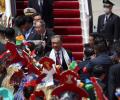
Wang Yang and Xi Jinping's visits signal the beginning of a major Chinese push to bring about a transformation of Tibet, observes Jayadeva Ranade, the distinguished China expert and retired RA&W officer.

'He still has to deal with party norms and traditions and has been careful to follow the order of seniority,' points out Claude Arpi.
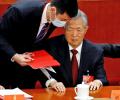
In scenes replicating purges at party conferences in Pyongyang, Xi Jinping appeared to borrow from Kim Jong Un's playbook when he had Hu Jintao, his predecessor as Communist party general secretary and president of the People's Republic of China, evicted from the final session of the 20th party congress on Saturday, October 22, 2022 in full view.

The week-long 20th national congress of the Communist party of China began in Beijing on Sunday, October 16, 2022.

A visit to Tibet appears to have become the new touchstone for expressing fealty to Xi Jinping, observes Jayadeva Ranade, the retired senior RA&W officer and distinguished China expert.
Was Wang Yi'S visit intended to remind India of 1962, asks Claude Arpi?

The Politburo Standing Committee -- the most powerful body in China -- is unveiled, but in a break from Communist party convention, no successor to Xi Jinping is named.

Statements emanating from the recent Chinese Communist party congress suggest potentially increasing pressure on India with regard to the Dalai Lama and the Central Tibetan Administration in Dharamsala, notes former RAW officer Jayadeva Ranade.

The Chinese Communist party has not closed its door of contacts and negotiation with the Dalai Lama, a senior Communist leader wrote recently. Former RA&W officer and China expert Jayadeva Ranade explains what the thinking on Tibet is likely in Beijing.

The entire gamut of China's activities is aimed at keeping India on tenterhooks, cause fatigue to its troops and keeping its security system unstable, so that it cannot play a meaningful role in international geopolitics as an effective partner of the US and Japan, observes Lieutenant General Syed Ata Hasnain (retd).

'Xi's emphasis on enhancing conventional military deterrence capabilities, joint operations and power projection are likely to increase friction points with India as with other nations,' points out China expert Srikanth Kondapalli.

'If one puts the context of what Xi Jinping said at the UN about not wanting a 'hot or cold war with any country', one realises that his speech was quite bizarre.' 'The world does not expect such statements from China, a nation aspiring to be a superpower.

'There are reports of political dissent mounting on Xi Jinping's handling of the Wuhan fallout.'

'Does it mean that we are witnessing the end of an era?' 'Probably not, but the post-Trump trade war has certainly brought a lot of instability in China,' notes Claude Arpi.

Important for India was Xi's meeting with representatives of PLA officers and soldiers stationed in Tibet. The video of the encounter was interesting to watch, especially the large number of lieutenant generals and major generals, observes Claude Arpi.
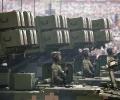
The first priority for the new Tibetan administration in Dharamsala should be to look at Tibetan recruitment in the PLA, suggests Claude Arpi.
 © 2026 Rediff.com - Advertise with us - Disclaimer - Privacy Policy - Sitemap - Feedback - About us - Terms of use - Grievances